When someone receives a cancer diagnosis, one of the first questions is often: “Why has this happened to me?”
And if there is no family history, the question weighs even more heavily: “How can this be, if nobody in my family has had cancer?”
The short answer is that, although genetics play a role, the vast majority of cancer cases, between 90–95%, are related to environmental factors and lifestyle habits that we can modify. Understanding this is not about finding someone to blame, but about regaining control: if your environment influences the disease, you have the power to positively influence your health and recovery.
Genes do not change in a century, but our environment does
One biological reality gives us perspective: the human genome takes thousands of years to change significantly. Yet in just 100 years, the world has changed radically.
If our genes are practically the same as those of our great-grandparents, but cancer diagnoses among younger people are increasing, we have to ask: What has changed? The answer lies in our modern lifestyle:
- Extreme inactivity: the human body is designed for movement, not for spending eight hours sitting in front of a screen.
- Processed food: we have replaced real food with industrial products, sugars and low-quality fats.
- Chronic stress and lack of rest: an immune system on constant alert cannot repair cells as effectively.
- Exposure to toxins: pollution and endocrine disruptors that did not previously exist are now everywhere.
This does not mean that one particular habit “causes” cancer on its own, but that it creates biological conditions that facilitate the disease.
Scientific evidence: the study that changed oncology
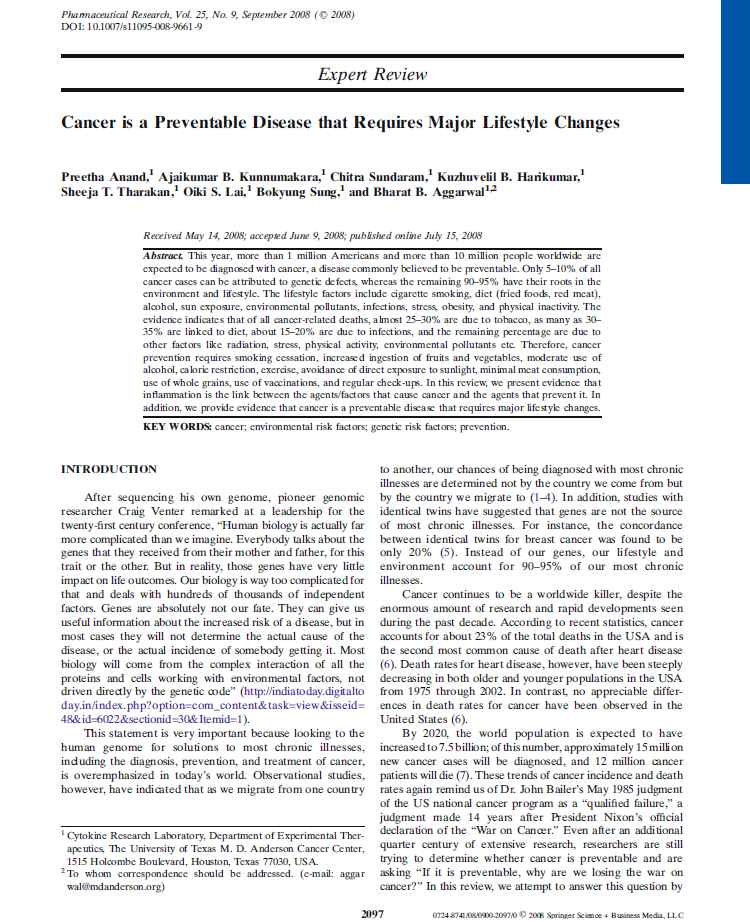
In 2008, a crucial review entitled Cancer is a Preventable Disease that Requires Major Lifestyle Changes presented data that today underpin modern oncology:
- Only 5–10% of cancers are purely genetic.
- The remaining 90–95% are due to lifestyle.
- Tobacco (25–30%) and diet/obesity (30–35%) are the most influential factors, followed by infections and physical inactivity.
The important point is not to fixate on a percentage as though it were a verdict. The important point is this: your body does not live in isolation. What you do each day influences your biology.
But influencing does not mean having 100% control. You can do many things right and still get cancer. And you can have done many things wrong and not develop it. That is why we must avoid simplistic interpretations.
And it should be clear that the useful question now is not: “What did I do wrong?”. The useful question right now is: “What can I do from now on to help my body?”
Regaining room for action
After a diagnosis, some things do not depend directly on you: the tumour type, the stage, tests, surgery, chemotherapy, radiotherapy, immunotherapy or hormone therapy.
But there are other areas where you may have room for action. And one of the most important is movement. You should know that properly prescribed exercise can help you:
- Maintain muscle mass
- Reduce fatigue
- Improve physical capacity
- Tolerate treatment better
- Improve metabolism
- Modulate inflammation
- Regain independence
- Regain confidence in your body
Exercise as your natural “medicine” at home
This is not about training like an athlete. It is about adjusting a dose that is realistic for your situation, giving your body the stimulus it needs to function better.
But you should know that this dose can change depending on your fatigue level, your stage of treatment, your pain, your previous exercise history, your blood test results and, above all, your ability to recover.
So on some days the aim will be to gain strength. On others, to maintain mobility. And on others, simply to avoid losing more capacity.
Conclusion
If you have had cancer without a family history, it does not mean there is a simple explanation or that it is your fault. Genetics matter, but environment and lifestyle also influence the biological conditions in which the disease appears and develops.
As physiotherapists, we see every day that the body has an astonishing capacity to recover if we give it the right stimuli. If modern habits have made us vulnerable, exercise is the most powerful tool for “resetting” the body.
Remember: “Although you cannot control everything, you can help your body be in a better condition to face the process.”
Sources
Written by
Miquel Galmés
Physiotherapist · Exercise and cancer-related pain
Physiotherapist with more than 7 years of hospital experience supporting people during and after cancer.
Do you have more questions?
We know this topic raises many questions: what type of exercise is safe, when to start, and what to do if you have fatigue, pain, metastases, anaemia or fear of moving. You can consult our Frequently Asked Questions to find answers to the most common questions.